

af Magazine
~The Asahi Glass Foundation’s web magazine on the global environment~


To Confront the Crisis, We Must Tell Stories of Hope: How Restoring Nature Leads to Better Lives
How should humanity confront the twin crises of climate change and biodiversity loss? Dr. Jeremy Leggett, one of the two laureates of the 2025 Blue Planet Prize, has been grappling with these challenges since the 1980s. As a scientist, environmental activist, and social entrepreneur, he has shifted roles throughout his career--applying science not to inspire despair, but to cultivate hope, while building practical solutions along the way. "It is absolutely possible to restore nature while enriching both people and the economy." Drawing from his own experience, Dr. Leggett reflects on his decades of work and shares what each of us can do to build a hopeful future. (Based on an interview conducted in May 2025 and his commemorative lecture in Tokyo on October 30.)
A Scientist, Environmental Activist, and Social Entrepreneur: Facing Crises Through Evolving Roles

Dr. Jeremy Leggett has been described by The Observer as "Britain's most respected green energy boss." Drawing on his scientific background, he has moved between activism and entrepreneurship to drive transformative change in addressing environmental issues.
"Climate change and biodiversity loss threaten our very existence. Addressing this crisis--and ultimately solving it--is the most crucial mission entrusted to our generation," Dr. Leggett states.
He first became fully aware of the seriousness of this crisis in the mid-1980s. As an earth scientist studying shale deposits*, he encountered a scientific paper that profoundly reshaped his thinking. It presented clear, logically grounded evidence that greenhouse gases were already altering the atmosphere and shifting Earth's climate system.
"It was so compelling," he recalls. "I began to wonder whether humanity could even survive if things continued on this path. At the time, my research was funded by major oil companies, and I felt I was in a position of defending the industry--effectively contributing to an existential crisis. I resigned and, from 1989 onward, decided to devote myself entirely to addressing climate change."
Leaving academia, Leggett joined Greenpeace International as Science Director. Grounding campaigns in scientific evidence, he and his colleagues urged governments and corporations around the world to recognize the climate threat and take action. Their work contributed to major international achievements, including the adoption of the Kyoto Protocol. Yet Leggett soon encountered a recurring response.
"I often met people from the business world. I explained the crisis and emphasized that business and environmental solutions could go hand in hand. Many responded, 'I see your point. If that's true, why don't you start a business?' That's what prompted me to leave the NGO and found Solarcentury, a company dedicated to solar power," Leggett recalled.
* Shale Deposits Shale deposits are layers of fine-grained sedimentary rock (a type of mudstone) that split easily into thin plates. The gas and oil trapped within microscopic pores and fractures are known as shale gas and shale oil. For many years, extracting these resources was considered technically challenging and economically unviable. After 2006, however, advances in research and new extraction technologies dramatically changed the landscape. Large-scale production became possible, enabling the United States to shift from an energy importer to a major exporter. This transformation, often called the "Shale Revolution," significantly reshaped global geopolitics and energy markets.
Real-World Solutions Already Exist: Restoring Nature While Enriching People and the Economy

In 1997--when the solar industry was still in its infancy--Leggett founded Solarcentury. "I wasn't confident it would succeed," he reflects, "but I was determined to make it work."
"Many people think a sustainable, hopeful future built on fast-growing markets is just a dream. But the rise of the solar industry proved otherwise. The solar market is a vivid example of the power of a new, transformative market," he explains. "As manufacturing costs fell, sales soared, and financial institutions poured in investment. Solarcentury grew with the market, both supporting and riding its rapid expansion."
By around 2010, Solarcentury had expanded far beyond the UK, operating in 16 countries across four continents, becoming one of the world's most successful solar developers. But Leggett emphasizes that solving climate change alone is not enough for humanity to thrive.
"To confront the deeply interconnected crises of climate meltdown and biodiversity loss, we must rapidly scale not only the clean-energy market but also a second market--one for nature recovery." He notes that the financial sector is already moving in this direction through new disclosure frameworks and investment guidelines that direct capital toward both climate and nature solutions.
To help catalyze this emerging market, Leggett founded Highlands Rewilding. The company unites environmental activists, ecological experts, and local communities, managing diverse landscapes in Scotland--from cattle pastures and native forests to peat bogs, moorlands, and the shore of Loch Ness. With a mission of "rewilding"--the restoration of natural ecosystems--the company promotes activities that link ecological restoration with community prosperity through large-scale rewilding and the exploration of regenerative agriculture.
"Our goal is to help make nature restoration a viable business," he says. "For governments, this provides a path to meet international biodiversity commitments while revitalizing rural economies. And companies increasingly need nature-recovery credits. Without engaging in nature restoration, businesses risk losing social trust--and ultimately the economic conditions that allow them to operate. A powerful convergence of interests is already forming among stakeholders. All we need now is the spark to ignite the fuse."
The "Forestry-Construction Pump": A Powerful, Proven Solution -- Japan's Satoyama Shows the Way
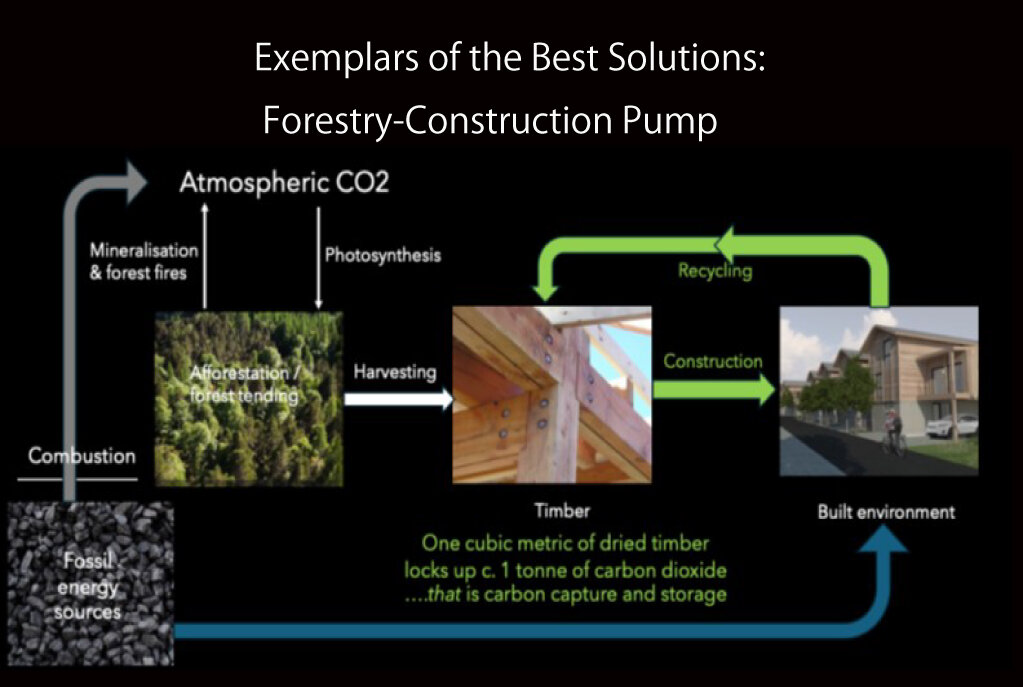
Leggett highlights concrete examples of proven, effective solutions--what he calls "proof of solution." He argues that scaling up such approaches is the surest path to averting the climate crisis. Among the many examples, the one he values most is the "Forestry-Construction Pump."
The idea is simple but powerful: 1. Restore or replant large forest areas to create healthy ecosystems capable of absorbing substantial amounts of CO₂. 2. Once the trees mature, selectively harvest a portion--while always planting more than are cut. Crucially, use most of the harvested timber as construction material. 3. By substituting timber for carbon-intensive materials such as concrete, steel, and brick, emissions are significantly reduced. Wooden buildings themselves act as long-term carbon stores, locking away the CO₂ absorbed by forests.
"This concept was introduced by Professor Hans J. Schellnhuber, a 2017 Blue Planet Prize laureate," Leggett explains. "His model has enormous potential--potential to help save the world." He notes that Japan is already ahead of many nations in integrating forest management, construction practices, and biodiversity conservation into a unified framework. "Japan's satoyama landscapes exemplify socio-ecological systems where forests, farmland, waterways, and human settlements coexist. They support remarkably rich biodiversity. This traditional landscape offers a practical roadmap--showing the world how to live prosperously in harmony with nature."
Hope, Stories, and Practice: Keys to Effective Communication-- "Please Engage in Work That Creates Hope"

Another major achievement in Leggett's career is his work with the nonprofit think tank Carbon Tracker, which he chaired from 2010. The organization helped catalyze a transformation in global finance by communicating the climate crisis in the language of financial markets. Through its analyses and reports, Carbon Tracker succeeded in convincing a broad audience that fossil fuels represent a financial liability.
Its landmark report demonstrated that--assuming global temperature rise must be limited--four-fifths of the world's listed fossil-fuel reserves could never be burned. Companies were therefore vastly overvaluing their fossil fuel assets, creating what Carbon Tracker identified as a "carbon bubble." This concept triggered a global wave of divestment from fossil fuel companies, reshaped the views of key financial leaders, and influenced the goals of the Paris Agreement.
Reflecting on this impact, Leggett says: "Neuroscience now tells us that human decision-making is far from purely rational. This makes it difficult for people to recognize crises and act on them. But Carbon Tracker demonstrated that when we frame risks in the language of an industry--transforming information into learning--people do respond."
Today, he notes, more people recognize that communication about crisis must fundamentally change. "If we talk about environmental destruction to people living on the front lines of inequality, it won't reach them. They face far more immediate concerns in their daily lives. We need to present climate and nature solutions as a hopeful story: a vision of a safer, more prosperous, more vibrant planet for everyone. With just a small shift in messaging, even those skeptical of ecological issues may find a reason to walk with us."
Throughout his life, Leggett has devoted himself to creating and sharing stories of hope. Drawing on decades of experience, he affirms with a smile that preventing catastrophe and improving people's lives are entirely compatible goals. To the younger generation, he offers this message--an invitation to engage in work that creates hope:
"My dream is to build a virtuous cycle in which nature restoration becomes a business opportunity, and that opportunity in turn accelerates further restoration. I hope the younger generation will join us in creating businesses that inspire hope for the future. There has never been a better moment to begin."
Profile
Dr. Jeremy Leggett
Founder & CEO, Highlands Rewilding
Inaugural Chair, Carbon Tracker Initiative
2025 Blue Planet Prize Laureate
Dr. Jeremy Leggett earned a D.Phil. in Earth Sciences from the University of Oxford. After conducting research on shale deposits at Imperial College London, he became aware of the looming threat of climate change and joined Greenpeace International as Science Director, leading its global climate campaigns. In 1997, he founded Solarcentury, which grew into one of the world's leading solar energy companies. In 2010, he became the inaugural chair of the Carbon Tracker Initiative, the think tank that introduced the influential concept of the "carbon bubble" and revealed the economic risks of fossil-fuel assets--accelerating the global divestment movement. Since 2020, Dr. Leggett has been leading Highlands Rewilding, a company he founded in Scotland dedicated to large-scale nature restoration. His current work focuses on building a market for nature recovery and developing new models that link ecological regeneration to sustainable economic opportunity.